
Hospital discharge checklist: bringing an older parent home
Updated 16 September 2026
Discharge rarely arrives with much notice. A doctor says the words on a ward round, and a family that had been visiting in shifts suddenly has to work out transport, medication, and who is going to be in the house on Thursday — often within a day.
This is a checklist for the family, not for the person coming home. It covers what to ask before they leave the ward, the one thing worth starting early, and how to stop the first week at home turning into a relay of half-remembered instructions.
Before they leave the ward
Most of what goes wrong in the first fortnight traces back to a question nobody asked while there was still someone in a uniform to ask. Write the answers down somewhere the whole family can see them.
Medications — what changed? Not just the list, but the diff. Hospital stays frequently change a prescription, and the version on the fridge at home is now wrong. Ask what was started, what was stopped, and what dose changed. Ask for it in writing, and ask who is sending it to the GP.
What happens next, and when? Is there a follow-up appointment, and is it booked or does someone need to book it? Is a public health nurse calling, and roughly when? Does the GP know they are coming home?
What should make us worry? Ask plainly: what are the signs that mean we ring the GP, and what are the signs that mean we go straight back to the emergency department? Families hesitate at 2am because nobody told them where the line was.
What does the house need? Equipment, a bed downstairs, a rail, help getting washed. Ask whether an occupational therapy assessment is part of the discharge, and ask whether a Community Intervention Team referral is available in your area — some hospitals can arrange short-term nursing support at home rather than keeping someone in.
Who is collecting them, and at what time? Obvious, and still the most common Thursday-morning scramble.
Start the home support application before discharge, not after
This is the single most useful thing on this page, and most families find it out too late.
You can apply for the HSE Home Support Service while your relative is still in hospital. The HSE states you can apply whether the person is at home, in hospital, or in a nursing home and hoping to return home. It is for people aged 65 and over — and in some cases younger people, for example with early onset dementia or a disability — who need help to keep living at home or to return home after a hospital stay. It covers everyday things: getting in and out of bed, dressing, washing.
It is also free. You do not need a medical card, and your income is not checked. Support is provided either directly by the HSE or by an HSE-approved provider. If a family wants more hours than the HSE offers, those extra hours are paid for privately. See HSE.ie — Home Support Service for older people.
Ask the ward, the medical social worker, or the discharge coordinator to start it. Starting the conversation before a discharge date is fixed is the difference between support arriving in the first week and support arriving in the fourth.
The first week home is where families come unstuck
The hospital hands over to one person — usually whoever happened to be there at the right moment. That person becomes the unwilling switchboard: the only one who knows what the doctor actually said, what the new dose is, and when the nurse is calling. Everyone else rings them to find out.
It is not a knowledge problem. It is a distribution problem, and it has a cheap fix.
A method you can set up tonight
1. One written handover. Whoever was at the discharge writes down the four things above — medication changes, next appointment, warning signs, what support is coming — in one place the family can see. A shared note, a photo of the discharge letter, a pinned message. Exactly one place.
2. Name the first fortnight rota out loud. Who is calling in on which days, and who is doing the first GP trip. Two weeks is enough — you can redo it. An unnamed rota defaults to whoever lives closest, and that is how resentment starts.
3. One point of contact with the hospital and GP. Ward staff change shift. A family ringing three times gets three partial answers.
4. Agree the same-day rule. If anything changes — a dose, an appointment, a nurse visit — it goes into the one place the same day. A list people trust gets checked. A list that might be stale gets ignored, and you are back to phoning each other.
Where the free method starts to strain
Plenty of families run the first month on a group chat and a notebook, and if yours is holding, keep it. The strain shows up in the same places each time. The handover note scrolls out of view in the chat within two days. The medication list and the appointment list live in different places, so nobody has the whole picture. And nobody can see what has actually been done — only what was asked. That last one is what produces the 11pm “did anyone take her to the GP?” message. Sharing a medication schedule across siblings has the same shape, and post-discharge is when it bites hardest, because the list has just changed.
Letting an app keep everyone in sync
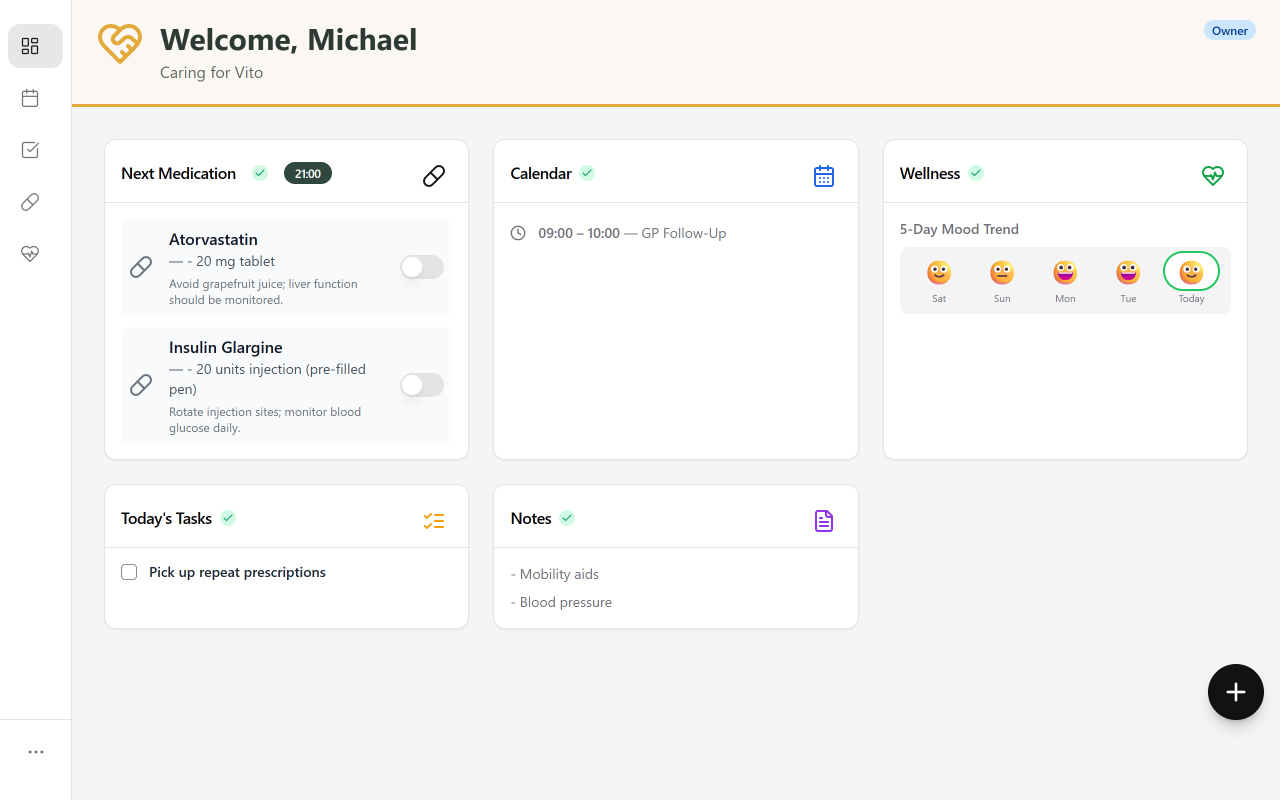
This is where a dedicated tool earns its place. In Kinclara, the family creates a Care Circle and puts the discharge information in once: the updated medications, the follow-up appointment, and the first fortnight’s tasks. From then on, everyone invited is looking at the same version.
The person who was at the hospital stops being the switchboard. A sibling who could not get to the ward can see what changed without anyone having to retype it, and can see what has already been done rather than asking.
Not everyone has to manage it. View-only access means a family member can read the schedule without being handed a job, and the family decides who sees what.
What it can look like
A composite drawn from what we see across beta families, not a single named case:
Dad, 78, home after eleven days following a fall. Three adult children, one of them in Manchester. The daughter who was on the ward at discharge came home with a folded letter and most of it in her head.
They put the discharge details in on the Sunday evening — two changed medications, an outpatient appointment six weeks out, and who was calling in on which days for a fortnight. On Wednesday the public health nurse adjusted something, and the son in Manchester saw it that evening without a phone call. By the end of the second week the daughter said the thing that had actually changed was that she had not had to chase anyone since the Tuesday.
One thing worth saying plainly: Kinclara coordinates the family around the care. It does not give medical advice and it is not a clinical tool. What is on the discharge letter is between your relative and their clinicians — the app only makes sure the whole family is working from the same version of it. If anything in this guide conflicts with what the hospital or GP has told you, they are right and this page is not.
Questions families ask
Can we apply for HSE home support before my parent leaves hospital?
Yes. The HSE says you can apply for the Home Support Service whether you are at home, in hospital, or in a nursing home and hoping to return home. Asking the ward about it before the discharge date is set is usually better than starting the process after everyone is home and the pressure is on.
Does home support cost anything?
No. The HSE Home Support Service is free. You do not need a medical card to apply, and your income is not checked. If a family chooses more hours than the HSE offers, the extra hours are paid for privately.
Who should be the family's point of contact with the hospital?
One person, named out loud. Ward staff change shift, and a family that phones in three separate times gets three partial answers. One contact who relays to everyone else is faster for you and easier for them — and it is the same principle that makes the rest of this work.
Is Kinclara free?
Yes. It's in free private beta, and core features will always be free to use.
If you do one thing before the discharge date, ask about home support. If you do one thing after, write the handover down somewhere everyone can see it — so the person who happened to be on the ward that morning is not the only one who knows.